
Blog

PRAY FOR THIS

A brief story to inspire you:
 

I recall hearing a respected Scottish preacher reminisce about a prayer meeting started in Scotland in the middle of the twentieth century. A couple of ruling elders in the Church of Scotland covenanted to meet together every week to pray for revival in their church. The sad state of the Church of Scotland today might cause one to question what effect their prayers had. But in the latter part of the twentieth century the Church of Scotland was served by some great evangelical pastors. As the story is told, the weekly prayer meeting never grew beyond those two elders, and after a couple of years of weekly meetings, their burden lifted and the prayer meeting disbanded – without any observable signs in answer to their prayers. However, some years later, it was calculated that many of those great evangelical pastors in the church were called and trained for the ministry during the period those elders were praying. 


– John Currie, The Pastors as Leader, p.108 (the story was confirmed from various sources)


You know you must pray. It’s the heart cry of a child of God. But sometimes you’re not sure what to pray for. Every Christian experiences this uncertainty at times.

The best way to begin – and to continue and grow – is to take seriously Christ’s own teaching on prayer. And I want to remind you, dear church, that on two separate occasions Jesus told his disciples to ‘pray earnestly to the Lord of the harvest to send our labourers into his harvest’ (see Matt 9.38 and Luke 10.2).

In Matthew’s gospel, Jesus said this in response to the need. He felt deep compassion for the crowds ‘because they were harassed and helpless, like sheep without a shepherd’, and so he told the disciples to pray for labourers. 

In Luke’s gospel, Jesus said this as he looked at the beginnings of a solution. He was about to send out seventy-two(!) preachers to go to different places – a large number of workers, but still far, far too few. So, he tells them ‘pray earnestly…’

There are a number of reasons why this requires earnest prayer. The people needed must truly feel called by God; they must be willing to endure the downsides and difficulties of the call; they must possess certain gifts; they need to have the right kind of character; they need to actually obey and say ‘yes’ to Jesus. 

I believe, therefore, that two things are true: First, the need is still there. There’s a harvest of salvation, and too few labourers – in our church, in our city, in our nation, in this world. Second, I believe that God responds to this divinely instructed prayer request.

Therefore, I want to charge you as a church: Pray earnestly, and pray every day, that God would raise up many workers. May we live both to witness and ourselves become a part of the answer to this prayer.

Lessons from the last seven years

As some of you know, I'm going on sabbatical soon. My last day is today. At Grace, our policy is that pastors receive a 12-week sabbatical for every seven years of service. This gives us time to step away from the day-to-day ministry of church leadership, to restore physically and spiritually, and to reflect, read and spend extended time with our families. Jen and I are incredibly grateful for this sabbatical. I'm also very thankful for an expanded staff team (Daniel, George, Pete etc.), that will share the pastoral and organisational load in my absence (alongside Andrew and Luke).

Seven years ago, I left my start-up job to work full-time for the church. At the time, it was a big adjustment. I exchanged the daily start-up hustle for theology books, pastoral meetings and some church administration. Looking back, it feels like the Lord had to do a lot of work in me. It took me quite a while to feel like I was thriving in ministry. Seven years later, I adore my job. Some might say, too much! I love the relationships I have across the church, the team I work with, the opportunity to walk with different people and to be regularly encouraged by what God is doing amongst us. Here are a few reflections that I've learnt along the way! 

1. I am not the Messiah! As a pastor, we're called to shepherd the flock God has given to us (1 Peter 5.2–5). This encompasses all sorts of activities, for example, speaking into peoples' lives, helping those who've become trapped in sin, or discipling someone through a specific challenge. I find this part of ministry very invigorating. And yet, the pastoral needs of the church can sometimes feel overwhelming. There are times when I fall into thinking that I'm responsible for solving people's problems. I have learnt to take great comfort from remembering that Jesus is the ultimate shepherd of the sheep. Psalm 127 reminds us that because the Lord is watching over (and building) his church, and so, we do not need to fill our lives with anxious toil. It's wonderfully releasing to remember he ultimately does not need us, but simply chooses to use us. 

2. Ministry flows out of your relationship with God. The most important thing I can do, in ministry, is to walk closely with the Lord. Everything we do is part of the overflow of our relationship with Him. We share most effectively from what he has been teaching us. We must avoid the temptation to simply 'summon up' enthusiasm for the Lord, and instead, regularly return to Christ, to receive from him, and then to invest in others. I need to keep remembering that the Lord is more interested in who I'm becoming rather than what I can do for him. 

3. Christians need the gospel. Early on in ministry, I used to think, 'every Christian already knows that Jesus died for their sins, I should probably tell them something new'. I was wrong. I've learnt that Christians constantly need to be reminded of the gospel, of the abundant love of Christ, of the welcome we receive at God's table, and of the never-ending mercy of God. We regularly fail to live as we should, and, sometimes, we feel utterly defeated. It's my (and others') privilege to lead wandering and bruised sheep back to the grace of God. As we remember and receive the grace of God, our hearts are turned to worship, we find the freedom to be honest about the sin in our lives and often experience a renewed desire to walk in holiness. 

4. The importance of multiplying myself. Over the last few years, particularly as the church has grown, I've felt the increasing importance of raising up leaders to support and encourage the church. I take inspiration from Barnabas, the apostle whose given name meant 'son of encouragement'. He got alongside Paul (Acts 9 & 11) and helped him to begin his apostolic ministry. His investment in Paul resulted in huge kingdom impact as Paul went on to take the gospel across the known world. As I've grown older, I've come to realise that I will have a far greater impact through others rather than trying to do it all myself. I want to spend the rest of my life raising up others to strengthen the church (e.g. pastors, life group leaders, evangelists etc.). And of course, we all have a part to play in serving the church. 

5. Expect conflict and pursue reconciliation. Over the past seven years, I've witnessed my fair share of conflict. And experienced some myself! I used to hide from conflict or pretend that it didn't exist. Most of us do the same. Unfortunately, unresolved conflict and hurt can fester and divide us from each other, which we don't want in the church (Eph 4.2). I've come to expect that we'll almost inevitably hurt each other (particularly as we build deep friendships). And yet, I've also witnessed the power of forgiveness. So, now, when I see hurt or conflict, I want to move towards it and actively pursue forgiveness and reconciliation. As you invest your life in the church, you may be hurt. But, unity is precious. Let's keep striving for it. 

The last seven years of working for the church have been a wonderful learning experience. It has been a real privilege and joy. We'll miss the church family over the next three months. It'll be great to be back with you in October. 

We must pray!

Something serious had happened. A woman in her twenties was on a call, walking quickly and speaking urgently. Phone in hand, headphones connected, she declared loudly, “WE MUST PRAY!”. It was the only logical and sensible advice she could give her friend. Whatever they were facing, prayer was the answer. She didn’t suddenly lower her voice in hushed solemnitude or opt to send the praying hands emoji. She was full of faith. It was a battle cry.


For me, it was a jolt. Faith in the public square! What boldness! Revival! But. Wasn’t she a bit loud? A little overly expressive? Does she really believe that, or was she just saying it?


I’m a Londoner, and unfortunately, cynicism is the air I have been breathing since birth. “Cynicism is the God of the thinking person”, said one pastor, and it often masquerades as discernment or a ‘healthy’ mistrust of people as it unpicks motives and dissects even a genuine smile. Of course, there are times when we ought to exercise significant caution and wisdom. Many of us have listened to The Rise and Fall of Mars Hill podcast, experienced the disappointment of those we should have been able to trust, or faced real pain that remains hard to fully understand.


The cynic, however, has allowed negativity and suspicion to become chronic, so much so that it distorts his view of God's character and paralyses his prayer life. Yes, we need to acknowledge what is truly broken about our world. Yes, the devasting effects of sin have infiltrated our hearts, our relationships and all of creation. But the Christian also knows that on the other side of brokenness is a real, solid, grounded hope. We have a Father who is more trustworthy than we can comprehend and the wonderful hope of redemption through Christ.


“The opposite of a childlike spirit is a cynical spirit” (Paul E. Miller). In Scripture, we are repeatedly reminded about how much Jesus loves children. Truly, I say to you, unless you turn and become like children, you will never enter the kingdom of heaven (Matthew 18). I thank you, Father, Lord of heaven and earth, that you have hidden these things from the wise and understanding and revealed them to little children (Luke 10). What is it to have a childlike spirit? A child is full of wonder and curiosity, not anxious about societal power dynamics or insincere motives. He knows he is pretty helpless and isn't ashamed of it. He also believes that his daddy is good and trustworthy, and is happy to rest in his embrace. This is the posture we are called to as we pray.


In our family, we’ve started declaring “WE MUST PRAY!” for the smallest things. Partly as a joke, but partly as a jolt out of cynicism. Brothers and sisters, let’s not confuse intelligence for cynicism, or childlike trust for naivety. Join me in repenting of cynicism and enjoying the wonderful hope of the gospel.


Some practical suggestions for journeying out of cynicism:

  • Go to bed. Sleep-deprived people struggle to pray and are more negative about most things

  • Read A Praying Life by Paul E. Miller. I can’t recommend it enough, and this email was inspired by it

  • Redeem the prayer hands emoji 🙏 by only sending it when you actually pray

  • Swap city breaks for forest breaks. Let the creativity of God move you to awe and prayer

  • Note down short notes every few days where God is showing you glimpses of his goodness, his work in the world, and how he is renewing all things

  • Spend time meditating on Psalm 91

You’re all ministers of the word

One of the greatest dangers churches face is the professionalisation of ministry, when the gap between the pulpit and the pew widens. At this point, church members become consumers instead of co-labourers, and the work of ministry is entrusted into the hands of a few. At this point, immaturity rules the day.

The New Testament has an entirely different view on how the church should operate. The place of leadership is never diminished, but the dignity and purpose of every individual – the priesthood of all believers – is elevated. When this happens, there is potency and life that flows through the body.

One of the core ministries of all believers (that includes you) is the ministry of the word. Aside from the authoritative preaching that is expected from ordained pastors, each person in the church family is entrusted to wield the word for the building up of the body.

This happens in numerous ways, but the main ones mentioned in the New Testament are these. First, there’s encouragement (see 1 Thess 4.185.11Heb 3.1310.25). This is not so much encouragement in the way we think of it – ‘You’re amazing! Back yourself! You’re gonna slaaaay’. Instead, it’s something like this: Putting courage into others by telling them the truth of what we believe; stoking up the fire of faith by helping others cling to the truth.

Second, there’s teaching (as in Col 3.16 or Titus 2.3). Obviously, not everyone is equally knowledgeable in the Scriptures. But the point here is that even if you know just a little bit more than someone else, you can teach them something. It might be a verse you read that morning that happens to be relevant at a particular moment talking to a friend.

Finally, there’s instruction or admonition. There’s a bunch of verses in the New Testament that use a Greek word noutheteo, which is translated differently in different places, but essentially it means this: Giving clear, directive, even forceful advice to someone. Take a look at Romans 15.14, or 1 Thess 5.1214, or or Col 3.16

I think of it like this. If the church is a group of people on a voyage together on the high seas, there are constant waves washing over the deck ready to sweep people overboard. Someone is experiencing doubts; another is caught in temptation; another is walking through suffering. At that point, when someone is about to get washed out to sea, the nearest person needs to throw out a hand and grab them without hesitation. That’s noutheteo – a readiness to speak the truth to each other with real conviction and to help each other do the right thing and stay on board.

All of this to say: You are a minister of the word. A healthy church involves your willingness to build up the body by speaking the truth of the gospel. So ask yourself, who needs to hear from you today? Who can you encourage? Who can you help?

Lessons from Japan

The Okinawan people of Japan have a tradition called moai. Groups of five children are paired together by their families and make a life-long commitment to each other. These groups of committed friends meet regularly over the decades to share their lives and provide financial support when necessary. A moai is a second family.


Recently, researchers found that being in a moai also significantly impacts life expectancy. Okinawan people in these groups often far outlive modern Westerners. Committed friendships provide joy and stability to their lives - and consequently keep them alive. 


Life-giving relationships like these aren't forged overnight but require time and intentionality. We rarely drift into deep friendships. Genuinely getting to know someone involves swimming against the tide of comfortable superficiality. It involves commitment akin to that in a moai
 

For us in London, this doesn’t mean we should literally create a moai or only have meaningful friendships with a group of five. Rather, there are ways we can foster deeper friendships with many of those we already know. We can make moai-like friendships out of existing ones.


One way to do this, which I've found valuable over the last year, is by using a simple framework for conversation: blessing, battle and breakthrough. It has proved helpful in deepening friendships by moving conversation past small talk and trivialities. Practically speaking, you may want to structure group discussion around each topic or pepper the questions into conversation. It's up to you.
 

1. Blessing
 

There's always something to give thanks for. Even when we suffer loss, we can still know Christ. In Him, we have “every spiritual blessing in the heavenly places” (Ephesians 1.3). Fortunately, there are also many material blessings to give thanks for, be it our health, provision, or relationships.
 

How are you experiencing God’s blessing?


2. Battle


Equally, as long as we live, we are in a spiritual war. And at times, it feels like we’re losing. We’re all battling sin, twisted desires, and impure thoughts. Our lives are more messy than we would like to admit.


The enemy would like us to keep our sinful actions, desires, and thought patterns hidden. Doing so may make us appear respectable, but it also leads to greater shame, guilt, joylessness and a culture of superficiality. In contrast, confessing before a trusted friend is liberating. It releases our bondage and leads us to repent before God.


Sometimes, the consuming battle may not be indwelling sin but testing circumstances. Loss, unmet desires, and pain weigh us down. We need a friend’s encouragement and prayers in these moments.


What sin/suffering are you battling?


3. Breakthrough


The Christian should be hopeful. The battle is skewed in our favour because Jesus is victorious over sin. So, we should expect to see God at work in our lives, renewing our minds and leading us to experience greater freedom. Perhaps you’ve also witnessed breakthrough through a change in circumstance or answered prayer.


Where can you see breakthrough?


Using these three Bs in conversation may at first feel clunky, but the rewards will hopefully be worthwhile. Building deep and committed friendships, like for the Okinawan people of Japan, will surely bring joy and vitality to our lives.

Nick & Jenn's reflections

Although we officially introduced Foundations only a few weeks ago, a three-month pilot of the course finished on Tuesday. We asked Nick and Jenn, who attended the pilot, to tell us about themselves and their reflections.


Tell us a bit about yourselves.

Nick: I was raised in Singapore and moved to London in August 2021 to pursue a master’s degree at LSE. My wife, Jenn, and I found Grace after a friend recommended it. We loved the Word, worship, and community and quickly settled in, joining Caleigh, Julie and Zach’s life group.

Jenn: I was born in Indonesia before moving to Singapore when I was four. I moved to London in 2021 to accompany Nick as he pursued further studies, and currently, I work as an Interior Designer.


Why did you decide to attend Foundations?

N: I've always been interested in learning about Jesus and have started reading the Bible more earnestly over recent months. Despite being a believer for most of my life, I had faith that the Lord would continue to speak to me at the course.


Was it what you expected?

J: Having attended church from a young age, I expected to hear things I already knew. However, the course prompted me to reassess my convictions and to pursue my own understanding of God rather than relying solely on others. It motivated me to discover a personal relationship with Jesus and seek a deeper connection with my Saviour.

Jenn and Nick

What was your biggest takeaway from the course? 

N: Week seven's discussion on growth was especially memorable. Daniel shared that as we grow in spiritual maturity, we become more aware of sin, and it pains us more than before. The fact that I am more conscious of my sin shows that God is working in me.

J: Week four's discussion on scripture altered my view of the Word and my relationship with the Bible, particularly as someone who previously struggled reading it. Now, I am committed to reading the Bible daily.


What would you say to someone considering Foundations? 

N: Foundations welcomes both new and seasoned believers! Trust that the Lord will reveal his Word to you in fresh ways.

J: There’s nothing to lose and everything to gain; go with an open heart and mind. Foundations has pivotally shaped my understanding of God’s Word and left us hungry for more.


Our upcoming Foundations course has reached capacity, but if you’d like to join the waiting list for the next one, please email info@grace.london. Find out more here.

Tips for having good conversations

Loving people is our greatest calling. And the simplest way to love other people is to learn how to have a good conversation. It’s often through a conversation that someone feels your warmth, your attentiveness, your interest, your care.

But by saying it’s simple, that does not make it easy. Many things conspire to stop a good conversation from ever happening. You don’t feel like it. Your head is elsewhere. You feel shy. You’ve got things to be getting on with. You’re experiencing interruptions. You have little in common.

A little while ago I came across an excellent and pithy article by Jonathan Noyes with some strong advise in this area. (He’s focussed on conversations that allow you to share your faith, but I think the principles apply more broadly.) Here are some of his tips:
 

Be present. 
 

‘Multitasking is a myth… This means you need to remove anything that might be a distraction from the conversation. Put your phone in your pocket until the conversation is over…

Being present, though, means more than simply removing distractions. It means being in that moment… Don’t be half in the conversation and half someplace else…

When you stay focused on the person you’re speaking to and remove distractions, you show you value him…’
 

Ask questions. 
 

‘Francis Schaeffer said, “If I have only an hour with someone, I will spend the first fifty-five minutes asking questions and finding out what is troubling their heart and mind, and then in the last five minutes I will share something of the truth.”

Schaeffer was on to something. Open-ended questions like “What matters most to you in life?” “What do you find confusing about Jesus and Christianity?” and of course, “What do you mean by that?” help you understand what a person thinks so you don’t misunderstand him — or worse, misrepresent him. Asking questions helps you understand what a person believes but also makes that person feel valued and heard. Questions can be disarming and often help bring down a person’s defensive walls…’
 

Listen intently. 
 

‘The number one tip I can give you to have a good conversation is to listen and be genuinely interested in the other person…

Just like with asking questions, as you listen, people become less guarded, more willing to open up and share their life with you… Steven Covey says, “Most people do not listen with the intent to understand; they listen with the intent to reply. They’re either speaking or preparing to speak.” Often, we don’t listen to what’s being said because we’re already working on a response in our mind instead of hearing all the other person has to say… Before you can have a good conversation, you have to be a good listener.’


As I said: simple but not necessarily easy. It takes practice – and you’ll have bad days as well as good. But, learning the art of conversation is truly a superpower in the call to love others.

Welcoming like Jesus

Think about the first time you arrived at Grace London. Some of you can even remember the first time you attended any church. How did you feel? Were you confident as you strode in, grabbed a coffee, and took your seat, effortlessly striking up a conversation with others around you?
 

I thank God for the extroverts among us who can resonate with that image to some degree, but that wasn’t my story the first time I visited a church. I still remember being chuckled at as I fumbled for my wallet to pay for the coffee. I mean come on, every Londoner knows that nothing’s really free. My first time at Grace London was certainly better but I am slightly too introverted to comfortably inject myself into conversations that could form the foundation of meaningful relationships. 
 

A reasonable application of Scripture is to greet one person we don’t know or don’t know well every time we gather with others in the body of Christ. We have been invited, welcomed and greeted by the Lord, and we can reciprocate by welcoming the outsider and the stranger. By welcoming the least, we welcome Jesus (Mark 9:37).
 

But however outgoing we naturally are, reaching out to people we don’t know can be difficult. There are some people we don't click with, some we don't like, and some who have wronged us. It’s good to move towards others, but it is not easy. The thought of awkward silence or feeling stupid can jeopardise the plan before we’ve even started.
 

So, what practical steps can we take? 
 

Firstly, start small with a greeting. Greetings are not a form of politeness from a bygone era. They are skills that imitate the Lord and show respect and kindness to others - and we are meant to grow in them.
 

There are, however, so many people we could greet. We shouldn’t aim to become serial greeters who offer a brief and boisterous “Good morning” before moving on to the next person. Instead, consider whom you are greeting and take time. This means our greeting list might be short because we only have limited time on a Sunday. We cannot talk to everyone. So, here is who you should prioritise:
 

  1.   The visitor (what Scripture calls the “foreigner” or “alien”) comes first.

  2.  The visitor who returns comes next.

  3.  The less popular, the marginalised, or those sitting alone come next.

  4.  Then come the children. Jesus singles them out as examples of the marginalised.

  5.  “Ні, _______!” is offered to as many people as possible, which doesn’t have to be accompanied by a hug or a hand-shake.
     

Good friends can, of course, intersperse these greetings.
 

As the King goes, so go his people. He moves toward people; we move toward people. He moves toward those who seek him and those who do not; we move toward those who want help and those who seem distant and marginalised. He moves toward friends and even enemies; we move out beyond our circle of friends to those far beyond that circle.
 

Imagine how this can transform our churches. Instead of talking to the same people – those with whom we are comfortable and who are similar to us – we treat others as God has treated us. Imagine how aloneness could gradually be banished.

Feeding stomachs and souls

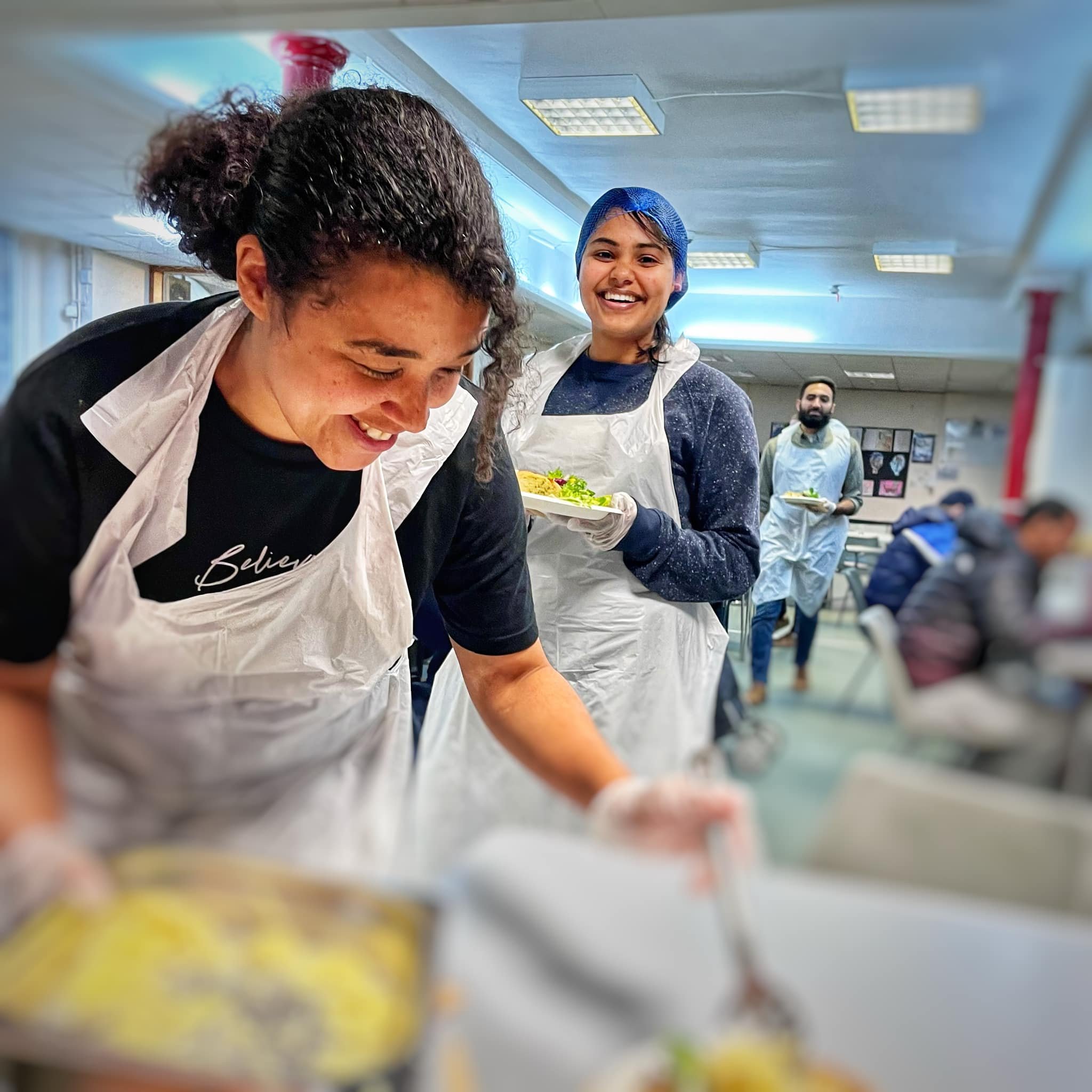
Webber Street is a day centre for London's homeless community, located around the corner from Waterloo Station and run by London City Mission. On the first Thursday of every month, volunteers from Grace help at the centre. They prepare a meal for around 40 people, give a short gospel-centred talk and spend time eating with the guests.

Bisi is one of our deacons and oversees the ministry. She tells us more.


Tell us a bit about yourself and how you got involved with Webber Street.

My name is Bisi and I live in north London with my 13-year-old nephew who keeps me busy. I currently work for Grace as a pastoral intern and provide administrative support for our digital comms.

It's always been on my heart to support the local community, so I was excited to get involved in Webber Street when the opportunity arose. A few members of our church work for London City Mission, and connected us with the centre. We've been helping provide these monthly evening meals for about a year now.


Why are you so passionate about this ministry?

I love how in the gospels Jesus notices and dignifies those that others overlook. Think about the woman with the issue of blood (Luke 8:43-48), or the woman at the well (John 4). God calls us to be a community who, like Jesus, sees the pain of those around us, and moves towards it. He calls us to bring the good news of Jesus to those in dire spiritual poverty. He calls us not to overlook those that others might.

But we don’t share the good news of Jesus with the homeless whilst ignoring their physical needs. We address both. We give the guests a meal and tell them the good news. We feed stomachs and souls.

I also feel passionate about this ministry as I've had a pretty messy family life myself, and resonate with many of the guests' situations. It's easy to write off rough sleepers as just another homeless person, forgetting the person behind the pain. Each person has a real story, and abandonment, abuse, and rejection are often involved. Comforting and listening to those who have been through so much is a way to show Christ’s love and bring healing to those who are hurting.


How can the church be praying or supporting Webber Street’s work?

We would love prayer for wisdom as we make plans for the future. We plan to start an evangelistic course in the summer for guests who are hungry to learn more about Jesus. Please also pray for the guests from Webber Street who have started coming to Grace! We are praying that the church community welcomes these people well and Grace becomes a place of warm welcome for the marginalised and homeless. 

We are always looking for new volunteers, so if the Lord has put it on your heart to serve in this way, please get in touch (bisi@grace.london). Come and check out a session or two and consider joining the team!


The Paradox of Leadership

Finding great leaders in any sphere – be it in the church or the world – is a difficult thing. I believe that this is because of a great paradox of leadership that can be summed up like this: Those who ought to lead are usually unable or unwilling, and those available and willing are least suitable to lead.

Very often, those most worthy of leadership in any sphere are (i) already deeply committed to fruitful work elsewhere, and (ii) self-effacing and therefore disinterested in position or recognition. And therefore, they are somewhat unavailable or unwilling to take on leadership.

On the other hand, those who are most available and eager to lead are often (i) available because they are not already deeply committed to fruitful work elsewhere, and (ii) least suitable or worthy for leadership precisely because of their eagerness to put themselves forward – a desire for recognition that eclipses any genuine ability or qualification for the role.

The political arena illustrates this paradox very well. The people we most need in political leadership as public servants are usually those who have demonstrated exceptional ability and character outside politics (e.g. in business, charity, or the military), and have no real interest in position or power. But, they may be reluctant to enter the political fray for these reasons. Then again, the people we least need in political leadership are usually those who have done nothing except pursue a political career, and are eager to climb into a position of power by whatever means possible. Such people often lack character, convictions, experience, and wisdom.

Surely, this is part of the reason why Jesus chose the most unlikely men as his apostles. He didn’t follow the typical pattern of the rabbis, who selected the most promising and able boys as their disciples. Christ’s men were not picked out from the rabbinical schools or drawn from the pharisaical elites. They were remarkable for the fact that they were ‘uneducated, common men’ (Acts 4.13). Maybe you could argue that Paul was an exception. But when Jesus called him, he had to undergo a complete dismantling of his former life with all his past ambitions and desires, so that he reached a point of true brokenness and humility.

There’s a profound challenge to us all in this.

For some, you may look at your life and see that God is using you in the work you’re doing. There’s real favour on your life. But you feel that you’re carrying a considerable load, and you don’t have a strong desire to step into something new. The challenge to you may be this: Are you wrongly avoiding God’s calling to leadership (whether in the church or the world), and are you withholding your gifts and experience in a way that is impoverishing others? Are you dodging the opportunities to step up, even though it’s clear to you and those around you that you have more to offer?

For others, you need to take a long look at yourself and ask why you are not being given the opportunities you crave. Are you really being faithful with what’s in front of you? Are you demonstrating a readiness to carry responsibility without pursuing recognition? Do you desire leadership too much, and what does that say about your heart?

Is male headship in marriage a dangerous idea?

A lot of people believe that the doctrine of male headship & authority in the home is a dangerous idea that inevitably leads to the oppression of women. Are they right?

The answer is not straightforward.

In her book, The Toxic War on Masculinity, Nancy Pearcey describes two contrasting pieces of evidence on this subject from a US context. On the one hand, she shows that, 
 

Compared to secular men, devout Christian family men who attend church regularly are more loving husbands and more engaged fathers. They have the lowest rates of divorce. And astonishingly, they have the lowest rates of domestic violence of any major group in America. (p.15)


In other words, on average, devout Christian men are better husbands than secular men. She then goes on to show an astonishing contrast:
 

Surprisingly, research has found that nominal Christian men have the highest rates of divorce and domestic violence – even higher than secular men. (p.15)


Here, ‘nominal’ means a person who identifies as Christian because of their background, but rarely goes to church. The research about such men is tragic and woeful:
 

They spend less time with their children, either in discipline or in shared activities. Their wives report significantly lower levels of happiness. And their marriages are far less stable. (p.37)


If devout men make the best husbands, then nominal Christian men make the worst. How can we explain that? 

When a man is truly surrendered to Jesus, then he understands his role as head of the home in a radically Christ-centred way. Having authority is in itself neither a good nor bad thing, neither safe nor dangerous in itself. The issue is what you do with that authority. And when a godly man understands his position of responsibility, and then interprets that authority by looking at the example of Jesus, then he seeks to follow that example in the power of the Spirit by laying down his life for his wife and children.

But when a man cherry-picks his theology by embracing male headship, but denying the demands of Christ to die to himself and live a life of surrender, then he becomes dangerous. He’s like a toddler playing with a weapon: He has power but no clue how to use it. In his selfishness and self-centred desires, he ends up abusing his authority and harming those nearest to him. He becomes a brute and a bully, grunting about his God-given rights and privileges, wielding his superior strength and stature to harmful ends, and wreaking destruction in his wake. He reads his Bible ‘through a grid of male superiority and entitlement’ and then manipulates its teaching ‘to justify [his] abusive behaviour’ (p.37).

And this is, in the microcosm of the family, the story of the world. It’s the story of divine power, might, and authority invested in humanity as the pinnacle of creation. Then of that power wielded to the oppression of one another and of the earth itself. But finally, it's the story of that calling to rule being redeemed in Christ Jesus, the selfless husband of his people, and gracious Lord of his creation. Maranatha! Our Lord, come!

The only Christian work is good work well done

"The Church's approach to an intelligent carpenter is usually confined to exhorting him not to be drunk and disorderly in his leisure hours, and to come to church on Sundays. What the Church should be telling him is this: that the very first demand that his religion makes upon him is that he should make good tables.

The only Christian work is good work well done. Let the Church see to it that the workers are Christian people and do their work well, as to God: then all the work will be Christian work, whether it is Church embroidery or sewage-farming."
 

- Dorothy L. Sayers, “Why Work?” (1949)

While table-making may no longer be a common occupation among sophisticated Londoners, the implications of Dorothy Sayers’ essay remain. The beauty of the gospel is for our whole lives, not just Sundays. We spend most of our time working, and there is so much that Christian teaching has to say to our vocational lives. 

We’ve opened applications for the January 2024 cohort of The City Fellowship (TCF), a nine-month discipleship program designed to equip you to live out the gospel in the work God has called you to. Redeemer Presbyterian Church’s The Gotham Fellowship inspired the program, which we ran for the first time in 2022 with a graduating class of twelve men and women. Seeing lives changed and men and women mobilised to integrate their faith and work was a joy. I am so happy to help bring this program back in 2024 with the help of Daniel Ogbonna and Robyn Burriss.

The City Fellowship Class of ‘22

The program is intense, but that is its secret sauce. Working through readings from the likes of Augustine, Owen, Bonhoeffer, and Keller will stretch you. The vulnerability that comes from being spiritually formed and the deep community that emerges will stretch you. The head-heart-hands approach to the material, which invites you to put learning into action, will stretch you.
 
Do you want to be trained and nurtured for effective and faithful leadership in your vocation and the world? If so, please find out more on our webpage and complete the application by mid-December. We will also be holding a virtual info session on Monday, 27th November, at 7pm, which you are very welcome to register for.