
Work & Vocation

The Death of Perfectionism

I was trying to finesse the final section of a song - trying, that is. 

The right melody and harmony just weren’t coming, and the more I tried to force it, the more my frustration grew and the less productive I became. Cue the negative feedback loop. One of my flatmates arrived home, and before he could barely catch his breath, I was in full vent, throwing idea after idea his way, hoping for some helpful steer. But in one off-the-cuff remark, I was completely disarmed: “I can be a bit of a perfectionist too,” he said calmly. It hadn’t occurred to me that this was my problem.

For many creatives - or productive types for that matter - perfectionism can become an enemy in disguise. It creeps up on us, dressed as ‘prudence’ or ‘thoroughness’ and steals our joy before we’ve even realised. We end up paralysed, or perpetually searching for the perfect solution, or note or phrase that might not even exist. As the French philosopher Voltaire famously put it, “the best is the enemy of the good.”

But what does the Bible have to say to the perfectionist?


Who are you trying to please?

“For am I now seeking the approval of man or of God? Or am I trying to please man? If I were still trying to please man, I would not be a servant of Christ.” Galatians 1.10

It should be said up-front that prudence, excellence, thoroughness and ambition are not nefarious in themselves - in fact they’re very godly qualities - but they can easily become distorted. For some of us, perfectionism can mask a deep-seated form of people-pleasing. We aim for ‘best’ because we fear being viewed as mediocre or the fallout from making a mistake. We want others to admire, appreciate and respect us, and so we try to prove ourselves and meet their (often imagined) standards. Perhaps for you, it’s less about others and more about proving yourself to yourself. Either way, it comes down to pleasing another human - be it your manager, family, peers or self.

But the Apostle Paul makes it clear from the passage above that it’s impossible to live for the approval of both man and God. Either we choose man and cease to be a servant of Christ, or we make Jesus’ approval everything and inevitably disappoint others in the process. There’s no middle ground.

Our perfectionism is therefore a more serious problem than we might have realised. Every time we choose to obsess over minute details in the hope of inching up the reputational ladder, we’re saying no to God's approval, trading one ‘well done’ for another. It's a subtle but deadly sin, one that leaves us less content and more insecure than before.

So, one helpful way I’ve found to fight this deceptive sin - albeit imperfectly, evidently - is by asking myself, “Who am I trying to please here?” The answer is usually pretty revealing - and helps discern a good course of action. If the answer’s ‘man’, then it’s time to stop the frantic obsessing, trusting that any unforeseen failures or flaws are okay, and can be weathered by God’s grace. And if the answer’s ‘God’, then I can continue with faith - just as the Apostle Paul did - despite others’ criticism or disappointment.

Living like this might not look immediately different on the surface; both the perfectionist and God-pleaser are responsible, thorough and ambitious, but underneath they look and feel very different. While one pursues the approval of others - whipping themselves up into a mess in the process - the other can be at peace, working for the (far more manageable!) audience of One. So, which do you choose?

These articles are 100% man-made, without the use of generative AI.

Biblical Creativity

What do the average banker and painter have in common? Probably not much. Their labours are utterly unalike. One works in an office, the other in a studio. One works with numbers, the other with colour. But despite their differences, the Bible bestows dignity on the work of both. The artist is as much a ‘worker' as the financier, and vice versa.

In a world which prizes productivity, this is important to note. Creative work does not make the world go round like money does. We would immediately feel the crushing effects of a financial crisis, but if every artist stopped working tomorrow, it would take longer to notice. However, the consequences would be similarly crushing if only different and more gradual. Life would slowly become less beautiful and vibrant. Culture would grow stale. While creativity doesn't hit productivity goals like other forms of work, it is equally vital.


Creativity is work

The Bible affirms the place of creativity in its opening pages. In Genesis 1, God gives Adam and Eve a mission: “Be fruitful and multiply and fill the earth and subdue it, and have dominion over the fish of the sea and over the birds of the heavens and over every living thing that moves on the earth.” (Genesis 1.28). 

God honours them with the responsibility to 'subdue' the earth, to tame a sinless but uncultivated world. Pre-fall creation was not corrupted, but neither was it finished. God looked at the world with delight - it was ‘good’ - but there was more to be done. Earth’s raw materials existed but remained untamed. So, God called Adam and Eve to create order in this beautiful but wild landscape.

Creating art is one way to subdue the earth. Just as farmers tame creation by ploughing and sowing, artists do so by composing and performing. Their materials are not seed and soil but colour, language and sound. So, like farming, gardening, or banking, creative work is honest work.


Creativity is hard

However, we often imagine creative work simply as musing for hours, waiting for a genius idea to strike. This notion only hinders us from viewing artistry as honest work. However, understanding creativity as a practice of cultivating God’s creation can help us.

As any labourer will tell you, cultivation requires persistent hard work, even in the driving rain. A farmer doesn’t wait for perfect circumstances or a particular emotion to get ploughing. There will be moments of joy and reward, but grit, patience, and endurance are anyways required.

Similarly, creative work is neither easy nor passive but, like any work, requires persistence. Understanding creativity as a form of cultivating shows us we needn’t wait for a stroke of genius. Like the farmer, we must work even when inspiration is lacking and circumstances are suboptimal. As painter Chuck Close said, “Inspiration is for amateurs — the rest of us just show up and get to work.”


Creativity blesses others

Finally, creative work done well demonstrates God’s kindness to others. Beautiful art, music, choreography, and architecture enrich our lives. Artistry nourishes our souls. It is one way God showers his common grace over humanity - and the world cannot do without it.

So, if God has gifted you with artistic talent and creativity, use it to his glory! Follow his command and cultivate the world through your creativity. Doing so may sometimes feel difficult or uninspired, but your labour will make the world more vibrant. Spend your life for the glory of God and the good of others, and start creating.

The only Christian work is good work well done

"The Church's approach to an intelligent carpenter is usually confined to exhorting him not to be drunk and disorderly in his leisure hours, and to come to church on Sundays. What the Church should be telling him is this: that the very first demand that his religion makes upon him is that he should make good tables.

The only Christian work is good work well done. Let the Church see to it that the workers are Christian people and do their work well, as to God: then all the work will be Christian work, whether it is Church embroidery or sewage-farming."
 

- Dorothy L. Sayers, “Why Work?” (1949)

While table-making may no longer be a common occupation among sophisticated Londoners, the implications of Dorothy Sayers’ essay remain. The beauty of the gospel is for our whole lives, not just Sundays. We spend most of our time working, and there is so much that Christian teaching has to say to our vocational lives. 

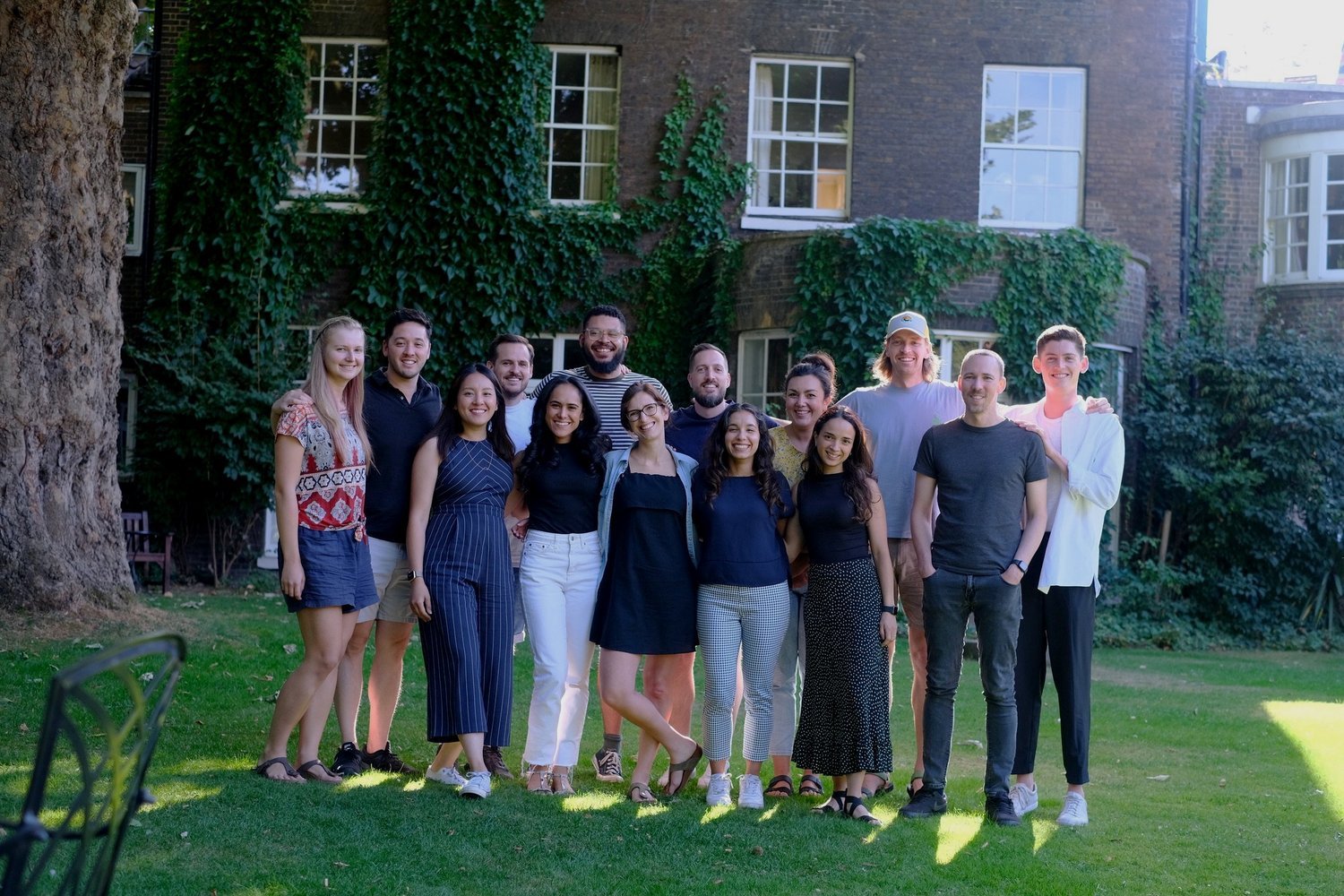
We’ve opened applications for the January 2024 cohort of The City Fellowship (TCF), a nine-month discipleship program designed to equip you to live out the gospel in the work God has called you to. Redeemer Presbyterian Church’s The Gotham Fellowship inspired the program, which we ran for the first time in 2022 with a graduating class of twelve men and women. Seeing lives changed and men and women mobilised to integrate their faith and work was a joy. I am so happy to help bring this program back in 2024 with the help of Daniel Ogbonna and Robyn Burriss.

The City Fellowship Class of ‘22

The program is intense, but that is its secret sauce. Working through readings from the likes of Augustine, Owen, Bonhoeffer, and Keller will stretch you. The vulnerability that comes from being spiritually formed and the deep community that emerges will stretch you. The head-heart-hands approach to the material, which invites you to put learning into action, will stretch you.
 
Do you want to be trained and nurtured for effective and faithful leadership in your vocation and the world? If so, please find out more on our webpage and complete the application by mid-December. We will also be holding a virtual info session on Monday, 27th November, at 7pm, which you are very welcome to register for.