

Blog

Feeding stomachs and souls

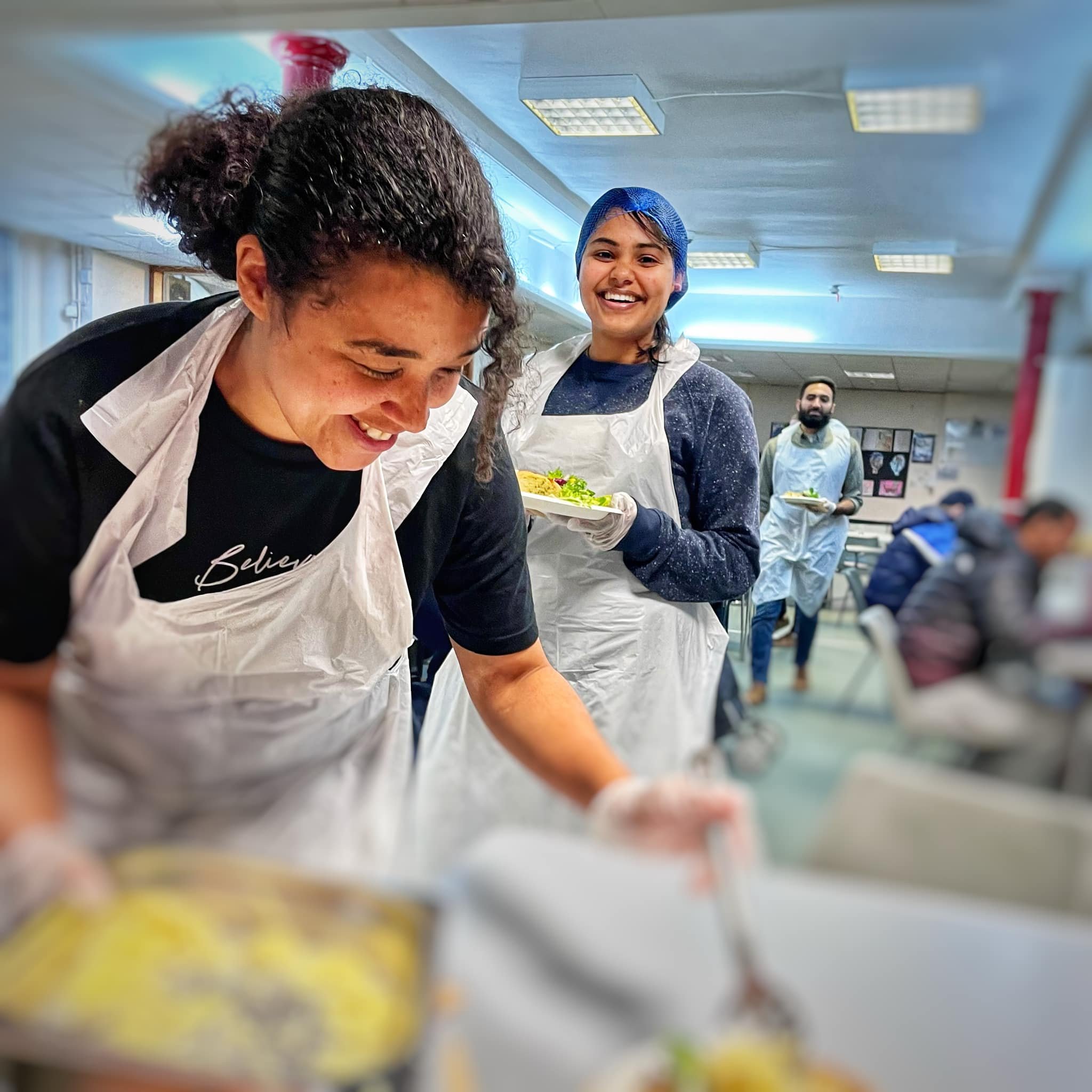
Webber Street is a day centre for London's homeless community, located around the corner from Waterloo Station and run by London City Mission. On the first Thursday of every month, volunteers from Grace help at the centre. They prepare a meal for around 40 people, give a short gospel-centred talk and spend time eating with the guests.

Bisi is one of our deacons and oversees the ministry. She tells us more.


Tell us a bit about yourself and how you got involved with Webber Street.

My name is Bisi and I live in north London with my 13-year-old nephew who keeps me busy. I currently work for Grace as a pastoral intern and provide administrative support for our digital comms.

It's always been on my heart to support the local community, so I was excited to get involved in Webber Street when the opportunity arose. A few members of our church work for London City Mission, and connected us with the centre. We've been helping provide these monthly evening meals for about a year now.


Why are you so passionate about this ministry?

I love how in the gospels Jesus notices and dignifies those that others overlook. Think about the woman with the issue of blood (Luke 8:43-48), or the woman at the well (John 4). God calls us to be a community who, like Jesus, sees the pain of those around us, and moves towards it. He calls us to bring the good news of Jesus to those in dire spiritual poverty. He calls us not to overlook those that others might.

But we don’t share the good news of Jesus with the homeless whilst ignoring their physical needs. We address both. We give the guests a meal and tell them the good news. We feed stomachs and souls.

I also feel passionate about this ministry as I've had a pretty messy family life myself, and resonate with many of the guests' situations. It's easy to write off rough sleepers as just another homeless person, forgetting the person behind the pain. Each person has a real story, and abandonment, abuse, and rejection are often involved. Comforting and listening to those who have been through so much is a way to show Christ’s love and bring healing to those who are hurting.


How can the church be praying or supporting Webber Street’s work?

We would love prayer for wisdom as we make plans for the future. We plan to start an evangelistic course in the summer for guests who are hungry to learn more about Jesus. Please also pray for the guests from Webber Street who have started coming to Grace! We are praying that the church community welcomes these people well and Grace becomes a place of warm welcome for the marginalised and homeless. 

We are always looking for new volunteers, so if the Lord has put it on your heart to serve in this way, please get in touch (bisi@grace.london). Come and check out a session or two and consider joining the team!


The Paradox of Leadership

Finding great leaders in any sphere – be it in the church or the world – is a difficult thing. I believe that this is because of a great paradox of leadership that can be summed up like this: Those who ought to lead are usually unable or unwilling, and those available and willing are least suitable to lead.

Very often, those most worthy of leadership in any sphere are (i) already deeply committed to fruitful work elsewhere, and (ii) self-effacing and therefore disinterested in position or recognition. And therefore, they are somewhat unavailable or unwilling to take on leadership.

On the other hand, those who are most available and eager to lead are often (i) available because they are not already deeply committed to fruitful work elsewhere, and (ii) least suitable or worthy for leadership precisely because of their eagerness to put themselves forward – a desire for recognition that eclipses any genuine ability or qualification for the role.

The political arena illustrates this paradox very well. The people we most need in political leadership as public servants are usually those who have demonstrated exceptional ability and character outside politics (e.g. in business, charity, or the military), and have no real interest in position or power. But, they may be reluctant to enter the political fray for these reasons. Then again, the people we least need in political leadership are usually those who have done nothing except pursue a political career, and are eager to climb into a position of power by whatever means possible. Such people often lack character, convictions, experience, and wisdom.

Surely, this is part of the reason why Jesus chose the most unlikely men as his apostles. He didn’t follow the typical pattern of the rabbis, who selected the most promising and able boys as their disciples. Christ’s men were not picked out from the rabbinical schools or drawn from the pharisaical elites. They were remarkable for the fact that they were ‘uneducated, common men’ (Acts 4.13). Maybe you could argue that Paul was an exception. But when Jesus called him, he had to undergo a complete dismantling of his former life with all his past ambitions and desires, so that he reached a point of true brokenness and humility.

There’s a profound challenge to us all in this.

For some, you may look at your life and see that God is using you in the work you’re doing. There’s real favour on your life. But you feel that you’re carrying a considerable load, and you don’t have a strong desire to step into something new. The challenge to you may be this: Are you wrongly avoiding God’s calling to leadership (whether in the church or the world), and are you withholding your gifts and experience in a way that is impoverishing others? Are you dodging the opportunities to step up, even though it’s clear to you and those around you that you have more to offer?

For others, you need to take a long look at yourself and ask why you are not being given the opportunities you crave. Are you really being faithful with what’s in front of you? Are you demonstrating a readiness to carry responsibility without pursuing recognition? Do you desire leadership too much, and what does that say about your heart?

Is male headship in marriage a dangerous idea?

A lot of people believe that the doctrine of male headship & authority in the home is a dangerous idea that inevitably leads to the oppression of women. Are they right?

The answer is not straightforward.

In her book, The Toxic War on Masculinity, Nancy Pearcey describes two contrasting pieces of evidence on this subject from a US context. On the one hand, she shows that, 
 

Compared to secular men, devout Christian family men who attend church regularly are more loving husbands and more engaged fathers. They have the lowest rates of divorce. And astonishingly, they have the lowest rates of domestic violence of any major group in America. (p.15)


In other words, on average, devout Christian men are better husbands than secular men. She then goes on to show an astonishing contrast:
 

Surprisingly, research has found that nominal Christian men have the highest rates of divorce and domestic violence – even higher than secular men. (p.15)


Here, ‘nominal’ means a person who identifies as Christian because of their background, but rarely goes to church. The research about such men is tragic and woeful:
 

They spend less time with their children, either in discipline or in shared activities. Their wives report significantly lower levels of happiness. And their marriages are far less stable. (p.37)


If devout men make the best husbands, then nominal Christian men make the worst. How can we explain that? 

When a man is truly surrendered to Jesus, then he understands his role as head of the home in a radically Christ-centred way. Having authority is in itself neither a good nor bad thing, neither safe nor dangerous in itself. The issue is what you do with that authority. And when a godly man understands his position of responsibility, and then interprets that authority by looking at the example of Jesus, then he seeks to follow that example in the power of the Spirit by laying down his life for his wife and children.

But when a man cherry-picks his theology by embracing male headship, but denying the demands of Christ to die to himself and live a life of surrender, then he becomes dangerous. He’s like a toddler playing with a weapon: He has power but no clue how to use it. In his selfishness and self-centred desires, he ends up abusing his authority and harming those nearest to him. He becomes a brute and a bully, grunting about his God-given rights and privileges, wielding his superior strength and stature to harmful ends, and wreaking destruction in his wake. He reads his Bible ‘through a grid of male superiority and entitlement’ and then manipulates its teaching ‘to justify [his] abusive behaviour’ (p.37).

And this is, in the microcosm of the family, the story of the world. It’s the story of divine power, might, and authority invested in humanity as the pinnacle of creation. Then of that power wielded to the oppression of one another and of the earth itself. But finally, it's the story of that calling to rule being redeemed in Christ Jesus, the selfless husband of his people, and gracious Lord of his creation. Maranatha! Our Lord, come!

The only Christian work is good work well done

"The Church's approach to an intelligent carpenter is usually confined to exhorting him not to be drunk and disorderly in his leisure hours, and to come to church on Sundays. What the Church should be telling him is this: that the very first demand that his religion makes upon him is that he should make good tables.

The only Christian work is good work well done. Let the Church see to it that the workers are Christian people and do their work well, as to God: then all the work will be Christian work, whether it is Church embroidery or sewage-farming."
 

- Dorothy L. Sayers, “Why Work?” (1949)

While table-making may no longer be a common occupation among sophisticated Londoners, the implications of Dorothy Sayers’ essay remain. The beauty of the gospel is for our whole lives, not just Sundays. We spend most of our time working, and there is so much that Christian teaching has to say to our vocational lives. 

We’ve opened applications for the January 2024 cohort of The City Fellowship (TCF), a nine-month discipleship program designed to equip you to live out the gospel in the work God has called you to. Redeemer Presbyterian Church’s The Gotham Fellowship inspired the program, which we ran for the first time in 2022 with a graduating class of twelve men and women. Seeing lives changed and men and women mobilised to integrate their faith and work was a joy. I am so happy to help bring this program back in 2024 with the help of Daniel Ogbonna and Robyn Burriss.

The City Fellowship Class of ‘22

The program is intense, but that is its secret sauce. Working through readings from the likes of Augustine, Owen, Bonhoeffer, and Keller will stretch you. The vulnerability that comes from being spiritually formed and the deep community that emerges will stretch you. The head-heart-hands approach to the material, which invites you to put learning into action, will stretch you.
 
Do you want to be trained and nurtured for effective and faithful leadership in your vocation and the world? If so, please find out more on our webpage and complete the application by mid-December. We will also be holding a virtual info session on Monday, 27th November, at 7pm, which you are very welcome to register for.